Lesson 5Liquidity Lab mini-noteRequired

Learn / ICT 2022 Model

ICT 2022 Model Main Lesson

Teach the complete ICT 2022 Model sequence after the prerequisite lessons.

How to use this page

Study the full model before drilling it.

Continue to Main Drill
  1. 1Watch Episode 2.
  2. 2Study the top-down model sequence.
  3. 3Review the EURUSD example.
  4. 4Continue to the Main Model Practice Drill.

Core source video

ICT 2022 Mentorship Episode 2

Start with Episode 2. This is the foundation for the ICT 2022 Model sequence: liquidity, stop hunts, MSS, FVG entry, premium/discount, and target logic.

Complete model framework

Weekly - Daily - Hourly context into execution.

This lesson is the bridge between prerequisites and Guided Replay. It teaches the model sequence as a decision framework, not as a video archive or a single-entry trick.

1

Build higher-timeframe context.

2

Identify draw on liquidity.

3

Mark obvious highs and lows.

4

Wait for the liquidity sweep.

5

Drop to the lower timeframe.

6

Confirm MSS.

7

Confirm displacement.

8

Use the FVG for entry.

9

Place stop loss beyond invalidation.

10

Target opposing liquidity, imbalance, or a dealing-range objective.

1. What the model is trying to do

The ICT 2022 Model is a liquidity-based execution model. The trader is not randomly buying or selling Fair Value Gaps.

The trader first builds a directional idea, identifies where liquidity is resting, waits for a liquidity event, then looks for confirmation through MSS and displacement before using the FVG as the entry zone.

2. Weekly chart

Each week before the new week begins, the trader tries to read what the next weekly candle may seek.

The question is whether price is likely to seek higher prices or lower prices. The goal is not to perfectly predict the weekly close. The weekly chart frames expectation.

Seasonal tendencies can be used as context, but they are not standalone trade signals.

3. Daily chart

The daily chart is where the trader identifies the main draw on liquidity. The market is usually drawing toward liquidity or imbalance.

Daily swing highs and swing lows matter because buy stops rest above swing highs and sell stops rest below swing lows.

The daily question: where is the obvious liquidity, where is the market likely drawing next, and is price reaching for stops or an imbalance?

4. Hourly chart

The hourly chart refines liquidity pools. Large traders and liquidity providers pay attention to old highs and old lows.

For a bearish expectation, if a significant move lower is expected, anticipate a possible stop hunt above a short-term high first.

For a bullish expectation, if a significant move higher is expected, anticipate a possible stop hunt below a short-term low first.

Lower-timeframe execution note

Once the stop hunt occurs, switch to the lower timeframes and start looking for small imbalances and a Market Structure Shift.

For index futures, the 1-minute, 2-minute, and 3-minute charts can be better than the 5-minute chart for finding imbalances because algorithmic delivery often appears more clearly on smaller timeframes.

This does not mean lower-timeframe gambling. The smaller chart is used only after liquidity has been swept and the model context is already present.

5. Liquidity sweep

A liquidity sweep is the stop hunt phase.

For a bearish model, buy-side liquidity is taken first. Then price should shift lower.

For a bullish model, sell-side liquidity is taken first. Then price should shift higher.

6. Market Structure Shift

MSS means Market Structure Shift. After liquidity is swept, price should break opposite short-term structure.

Bearish: after buy-side liquidity is taken, a short-term low is broken.

Bullish: after sell-side liquidity is taken, a short-term high is broken.

7. Displacement

Displacement is the strong move away from the swept liquidity. It shows urgency and often creates imbalance.

If there is no clean displacement, the setup is lower quality or may be a No Trade.

8. FVG entry

The Fair Value Gap is the imbalance used as the entry zone after MSS. The trader is not buying or selling every FVG.

The FVG matters because it appears after liquidity is taken and structure shifts.

Entry can be refined by FVG touch, FVG consequent encroachment / 50%, or the opening boundary of the FVG depending on the example and model rules.

9. Stop loss logic

For a short, stop loss should generally be above the invalidation high, often above the first or second candle high around the displacement/FVG sequence.

For a long, stop loss should generally be below the invalidation low, often below the first or second candle low around the displacement/FVG sequence.

The stop belongs beyond the price point that invalidates the displacement/FVG idea.

10. Take profit logic

For targets, use liquidity, imbalance, and dealing range logic. Draw the range from low of day to high of day, or high of day to low of day depending on direction, and highlight the 50% level.

Above 50% is premium. Below 50% is discount.

If selling from premium, look for exits toward a short-term low, sell-side liquidity, or an imbalance on the discount side.

If buying from discount, look for exits toward a short-term high, buy-side liquidity, or an imbalance on the premium side.

TP1 is the primary scored target. TP2 is an optional extended target.

11. No Trade / invalidation rules

Do not trade if liquidity is swept but MSS does not confirm.

Do not trade if MSS happens but there is no clean displacement.

Do not trade if the FVG forms but price spends too long inside it.

Do not trade if the target is unclear, the setup forms too late, price action is too choppy, or the model sequence is incomplete.

Missing a trade is better than forcing a weak model.

Full example

EURUSD - Bullish ICT 2022 Model Example

This is an educational example, not financial advice.

Market

EURUSD

Source

FOREXCOM / TradingView

Date

Tuesday 8 Apr 2025

Session

NY AM / Lunch

Model type

Bullish ICT 2022 setup

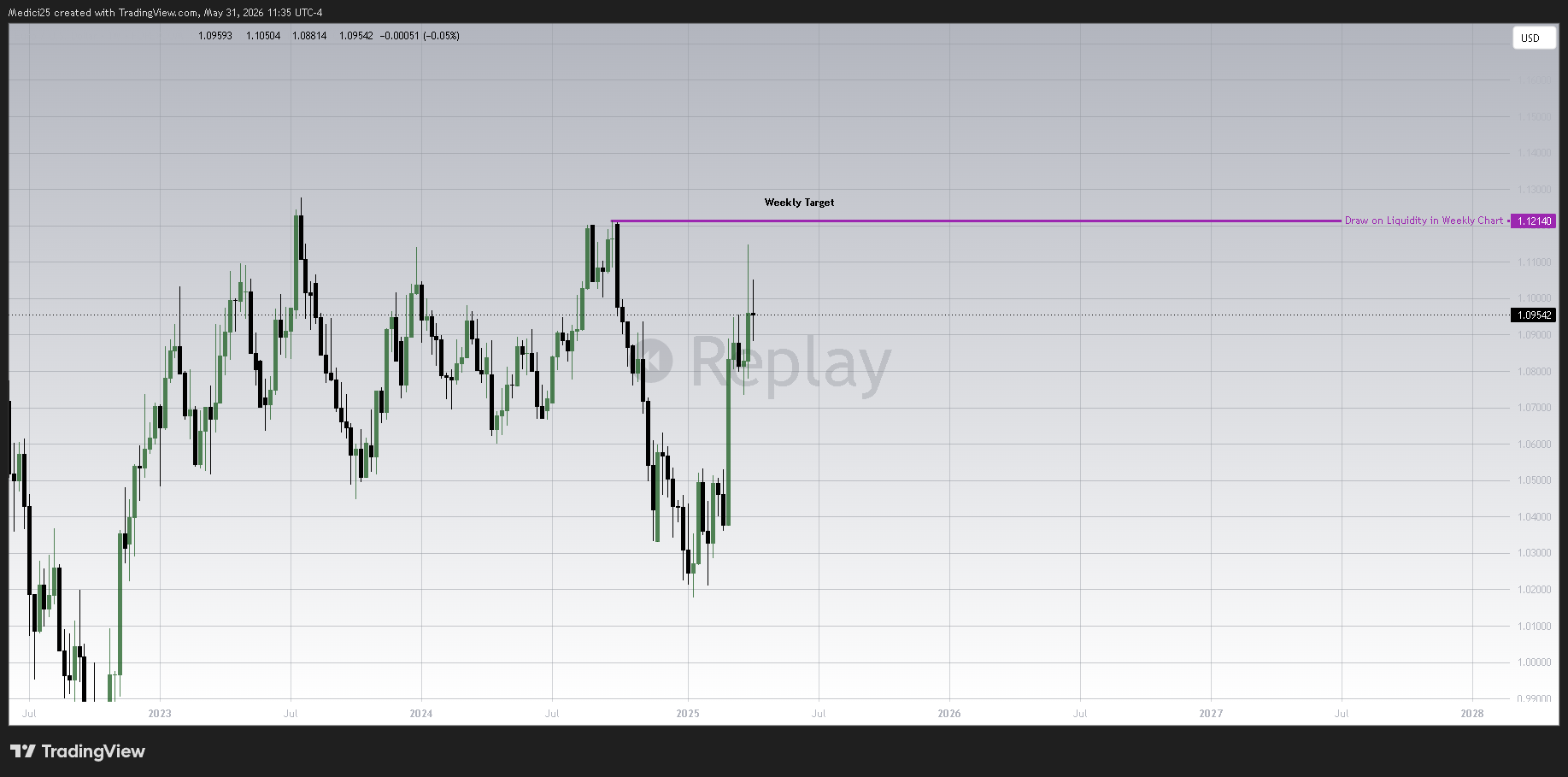
Weekly context for the EURUSD 8 Apr 2025 ICT 2022 example

Weekly context

Higher-timeframe draw is framed before execution.

Open image in new tab
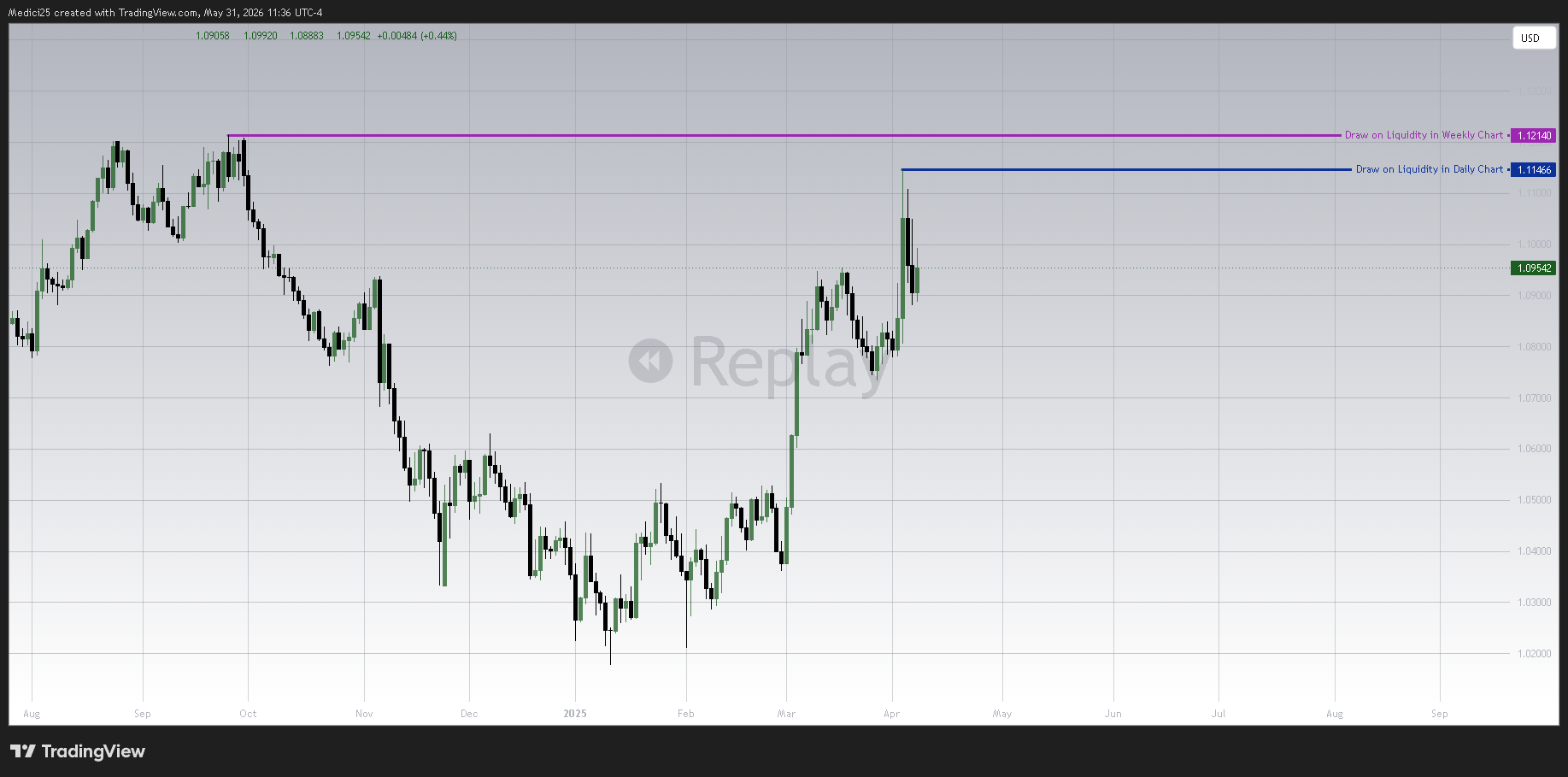
Daily context for the EURUSD 8 Apr 2025 ICT 2022 example

Daily context

Daily chart refines the draw on liquidity.

Open image in new tab
Hourly liquidity sweep context for the EURUSD 8 Apr 2025 ICT 2022 example

Hourly liquidity sweep context

Sell-side liquidity is identified and swept.

Open image in new tab
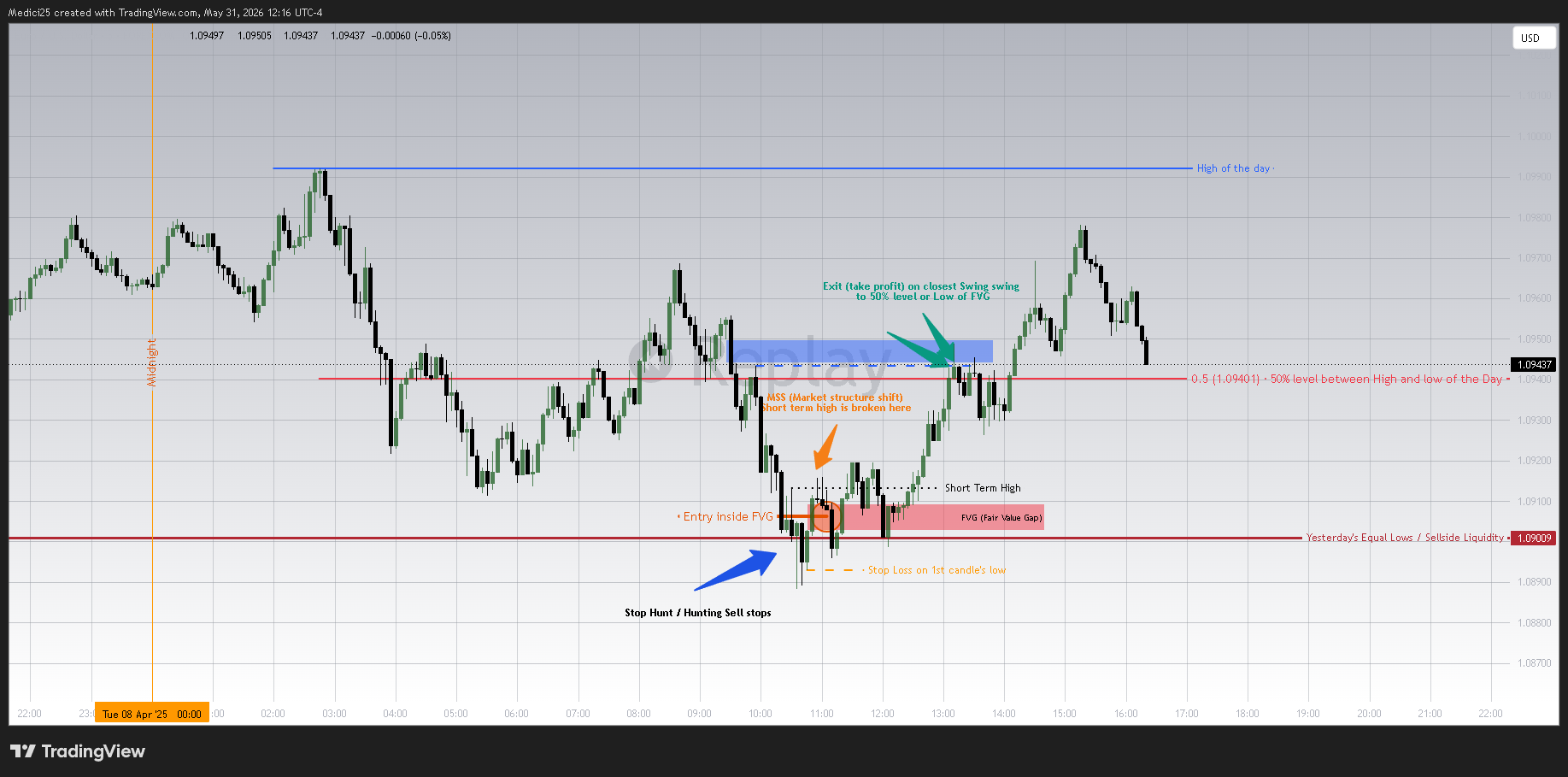
5-minute execution model for the EURUSD 8 Apr 2025 ICT 2022 example

5-minute execution model

Lower-timeframe MSS and bullish FVG create the execution model.

Open image in new tab

Context

Weekly context shows a higher-timeframe draw on liquidity above price. Daily context refines the draw and supports the idea that price may be drawing higher.

Hourly liquidity

The hourly chart shows yesterday's equal lows / sell-side liquidity near 1.09009. Price trades below that level and sweeps sell-side liquidity.

5-minute execution sequence

1

Sell-side liquidity is swept.

2

Price shifts away from the swept low.

3

A short-term high is broken.

4

MSS confirms.

5

A bullish FVG forms.

6

Entry is inside the FVG.

7

Stop loss belongs below the invalidation low.

8

Target is toward the 50% level, opposing liquidity, or a premium-side imbalance.

Homework

1

Mark weekly expectation.

2

Mark daily draw on liquidity.

3

Mark hourly liquidity.

4

Identify the sweep.

5

Mark MSS.

6

Mark displacement.

7

Mark the FVG.

8

Define entry, SL, TP1, and TP2.

9

Decide if the setup is valid or No Trade.

10

Backtest several weeks before using the model live.

Extra Study

Episode 3: internal range liquidity and MSS.

Episode 4-5: timing, stop hunt, and journaling.

Episode 6: bullish/bearish FVG structure and displacement.

Later episodes: advanced structure, Power of 3, psychology, and risk.

Continue

Move from framework to reps.

Notes

The ICT 2022 Model is a liquidity-based execution model. The trader is not randomly buying or selling Fair Value Gaps.

The trader first builds a directional idea, identifies where liquidity is resting, waits for a liquidity event, then looks for confirmation through MSS and displacement.

The Fair Value Gap becomes the entry zone only after liquidity is taken and structure shifts.

The higher-timeframe read starts with Weekly expectation, then Daily draw on liquidity, then Hourly liquidity refinement.

A valid model can end in Long, Short, or No Trade. Missing a trade is better than forcing a weak model.

Practice idea

Full model rehearsal

Mark weekly expectation.
Mark daily draw on liquidity.
Mark hourly liquidity.
Identify the sweep, MSS, displacement, and FVG.
Define entry, stop loss, TP1, TP2, and invalidation.
Decide if the setup is valid or No Trade.
Practice drill

Key rules

Build higher-timeframe context before looking for a lower-timeframe entry.

Identify draw on liquidity, obvious highs and lows, and the likely liquidity event.

After the sweep, confirm MSS and displacement before using the FVG as the entry zone.

Stop loss belongs beyond the price point that invalidates the displacement/FVG idea.

Targets should use liquidity, imbalance, premium/discount, and dealing-range logic.

If the model sequence is incomplete, the correct decision can be No Trade.

Warnings

Do not force a trade because one piece of the model appears.

Do not treat any random FVG as a 2022 Model setup.

Do not ignore timing, session behavior, or invalidation.

Do not use seasonal tendency, bias, or one timeframe as a standalone trade signal.

Do not move from Learn to replay until the sequence can be explained in order.

Finished this lesson?

Continue the path.

Continue to the next Learn lesson, practice the matching drill when one exists, then finish with Practice and Guided Replay.